
What Happens When Creativity Has No Ceiling: The Real Possibilities of AI and the Human Imagination
We have spent so much time asking what AI will take from us. We have barely begun asking what it might help us become.

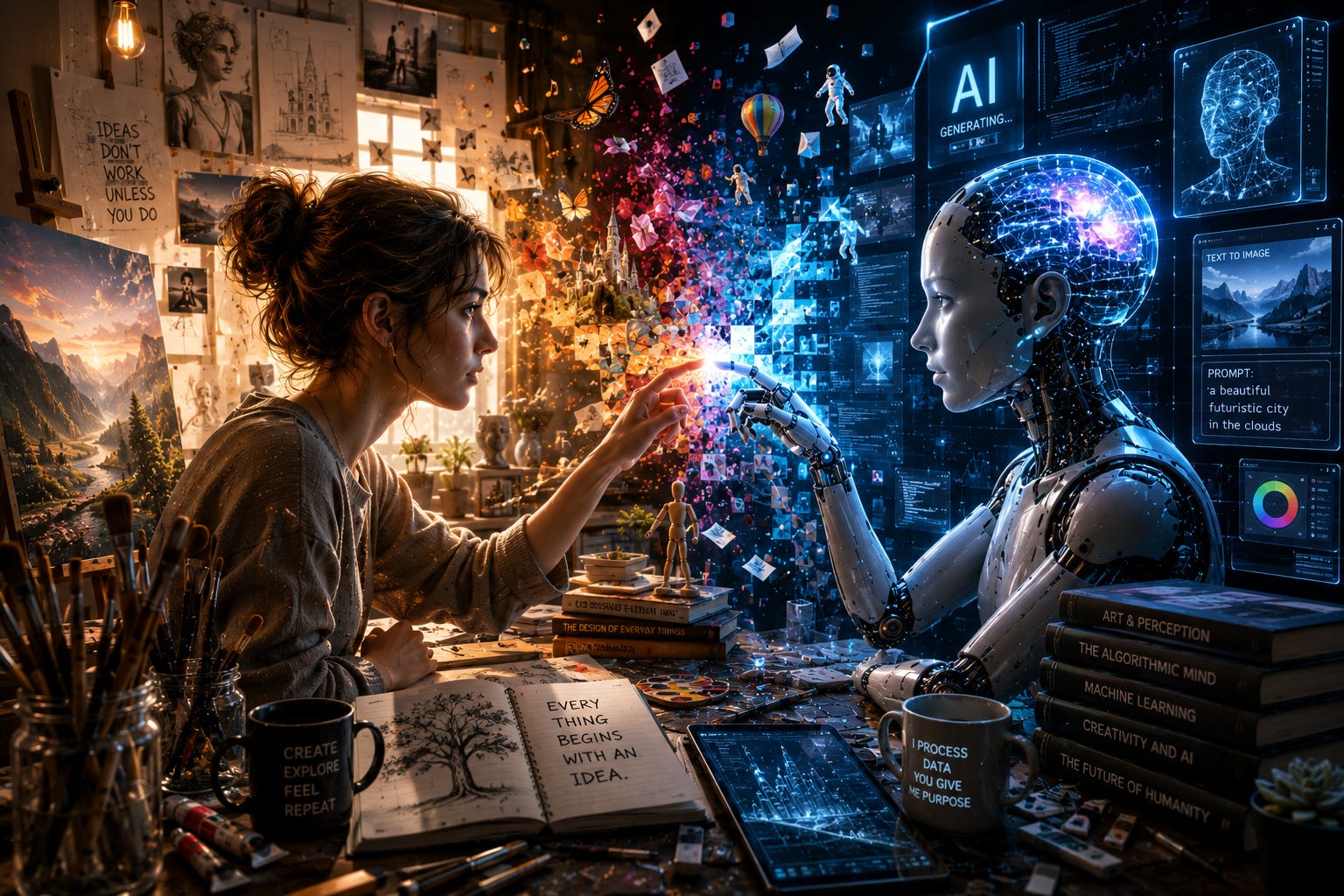
The conversation about AI and creativity has been dominated, understandably, by fear. Fear of job loss. Fear of homogenization. Fear that the things we make will matter less because machines can approximate them in seconds for a fraction of the cost. Those fears are not baseless. They deserve serious engagement, and they are getting it — in courtrooms, in Congress, in studios and editorial meetings and art schools around the world.
But fear is a narrow lens. And it may not be the most useful one for people who actually want to make things in the world as it is becoming.
Because alongside the disruption, something else is happening. Something quieter than the lawsuits and stranger than the job displacement reports and, in many ways, more exciting than either of them. Creative people are picking up these tools and doing things with them that nobody predicted — including the people who built the tools.
This piece is about those possibilities. Not the breathless techno-optimism that papers over every legitimate concern with a promise of abundance and a stock chart pointing up. The real ones. The ones that change what it means to have an idea, to pursue it, and to share it with the world.
Let’s start at the beginning. Which is also, fittingly, the oldest problem in all of creative history.
The Gap
Every person who has ever tried to make something knows the feeling.
You have an idea. It lives inside you with a clarity that feels almost physical — you can sense its shape, its emotional weight, the precise quality of the thing you are trying to bring into existence. And then you sit down to actually make it, to paint it or write it or build it or sing it, and what comes out is a pale and clumsy approximation of the thing you had in your head. The idea was vivid. The execution is... approximate. Embarrassing, even.
This gap between vision and execution is one of the oldest frustrations in the history of making things. Michelangelo allegedly said the sculpture already exists inside the marble, and the artist’s job is simply to remove everything that isn’t it. Inspiring. Also completely useless if you have been alive for fewer than sixty years and have not spent thirty of them learning to use a chisel. Most of us do not live in the marble. We live in the gap.
Here is what AI does to the gap: it narrows it.
Not perfectly. Not without creating interesting new gaps of its own. But genuinely, for a wider range of people than ever before in history.
A writer who has a clear structural vision but struggles to find the right sentence can use AI to generate language that approximates her intentions, then revise it into something that actually sounds like her. A visual artist with strong compositional instincts but limited technical skills in a new medium can use AI to produce starting points that he then distorts and overpaints and fights with until something distinctly his own emerges from the wreckage. A musician who hears complex orchestration in her head but cannot notate or produce it alone can use AI as a translation layer between her imagination and the sound file.
In each case, the vision belongs to the human. The AI is not the author. But it is a bridge across the gap, and for some people, that bridge is the difference between an idea that lives only in their head and one that exists in the world where other people can encounter it.
The ideas that never get made are not only a loss to the person who had them. They are a loss to everyone who would have been moved by them, given language by them, changed by them. The gap has been silencing people for centuries. It is genuinely good news that it is getting smaller.
The Collaborator Who Never Gets Tired (or Precious)
There is a specific kind of creative loneliness that professional artists rarely talk about publicly because it sounds like complaining, which is not a great look when you have a job most people would envy.
It is the loneliness of the early stages of a project. Before you have shown anything to anyone. Before there is a finished thing to defend or explain. When you are still in the territory of half-formed ideas and wrong turns and drafts so embarrassing you would rather lose them in a house fire than let another human being read them. That stage is essential. It is where the actual creative work happens. And it is deeply, specifically isolating, because there is no one to think with.
What you need in that early stage is a collaborator with very particular qualities: responsive but not dominating. Generative but not precious about their own ideas. Willing to try anything without judgment. Able to produce ten bad versions of something in order to help you understand what the good version should be. Available at 2 a.m. on a Tuesday. Completely indifferent to your ego.
No human being has all of those qualities. Human collaborators get tired. They get defensive about their ideas. They have opinions about the project that are shaped by their own aesthetic preferences and career interests. They are asleep at 2 a.m. They remember when you were mean to them about their last idea. They are, in short, people — which is wonderful in life and often complicated in early creative process.
AI is not a person. And in the early stages of making something, that is occasionally an advantage.
It will try anything. It does not get precious. It does not need you to justify why you want what you want or defend a choice you made two sessions ago. It does not judge the embarrassing draft. It just responds, and generates, and responds again, until you have enough material to understand what you are actually making.
Writers have described using AI as a thinking partner in the generative phase — not to produce prose they plan to use, but to think out loud without the self-consciousness of showing work to another person. Filmmakers use AI image tools to visualize scenes before writing them, testing whether an idea has visual life before committing the words that will have to carry it. Architects generate dozens of structural possibilities in an afternoon, not looking for the answer but mapping the space of what is possible before choosing a direction.
In each case, the AI is not the creator. It is the mirror that lets you see your own thinking more clearly — and that is, in many creative situations, exactly what you need.
Worlds That Could Not Have Existed Before
Some of the most interesting possibilities of AI and creativity are not about doing existing things faster or cheaper. They are about doing things that were previously impossible — full stop, regardless of budget, regardless of skill, regardless of how many people you put on the project.
Consider scale. A novelist can describe a world in words. A filmmaker can show parts of it. But the experience of actually inhabiting a fully realized world — one with consistent internal logic, visual coherence across every surface and angle, atmospheric depth at every scale from the citywide to the intimate — has historically required either a team of hundreds working for years, or the compromise of leaving most of the world implied rather than shown.
AI changes the math of world-building. A single writer with a strong visual imagination and the ability to direct AI tools precisely can now create environments of a richness and consistency that previously required entire studios. This matters not just for games and film but for every art form that involves imagined spaces: novels, architecture, installation art, theatrical design, and interactive experiences that do not yet have names because they do not yet fully exist.
Consider time. Some creative ideas require a timeframe that no single human life can accommodate. A composer who wants to create music that evolves continuously over fifty years — genuinely responding to the acoustic environment of a specific building as the building ages, as the city around it changes, as the culture shifts — is describing something no human composer can execute alone. With AI, that idea is no longer impossible. It is merely an engineering challenge, and engineering challenges are the kind of thing that tends to get solved.
Consider medium. Human beings have been making art in roughly the same basic mediums for most of recorded history: sound, image, movement, language, built space, and combinations of those. AI opens the possibility of art made in mediums that do not yet fully exist: generated environments that respond to the biometric state of the person inside them; soundscapes that adapt in real time to the emotional tenor of a conversation; visual forms that evolve according to where the viewer’s attention lingers. These are not science fiction scenarios. They are early-stage realities that creative people are actively building inside.
The question is not whether these possibilities are interesting. They obviously are. The question is whether the humans working inside them are still bringing something that the machine could not generate on its own. For now, the answer is yes. But only if they insist on it, which is a reasonable thing to insist on.
The Translator Between Disciplines
Here is something that has been true for most of human history and is rarely stated plainly: becoming genuinely fluent in more than one creative discipline is so difficult as to be nearly impossible for most people.
The musician who is also a serious visual artist. The architect who writes meaningful fiction. The novelist who can bring a genuine working understanding of neuroscience to bear on character without it reading like a textbook with dialogue. These people exist. They are remarkable. They are also extraordinarily rare, because developing real competence in any one field takes most of a creative life, and developing it in two leaves almost no time for a third, and developing it in three requires either unusual genetic gifts or a willingness to sleep very little.
This has meant that the most interesting creative territory — the unmapped space between established disciplines, where no single field has built its walls yet — has been largely inaccessible to most people. You needed to be a polymath or a very lucky collaborator to work there.
AI is beginning to act as a translator between disciplines, and this is one of the most genuinely underappreciated things it does.
A composer who wants to create visual art that is structurally isomorphic with her music — that obeys the same rhythmic logic, the same patterns of tension and release, the same harmonic relationships expressed now in color and form rather than sound — previously had two options: develop an entirely separate visual practice over many years, or find a visual artist who understood her musical thinking well enough to translate it precisely. Now she can work directly with AI to generate visual forms that correspond to musical structures, then direct and edit those forms toward something that carries her specific intentions.
A marine biologist who has spent her career studying bioluminescence and wants to communicate not just the science but the experience of it — the profound strangeness of light made by living things in complete darkness — previously needed to either develop filmmaking or writing skills that most scientific training does not provide, or hand the communication off to someone who had not spent years in the water. AI lowers that barrier dramatically, not eliminating the need for the scientist’s knowledge but making it possible for that knowledge to find a form that non-scientists can actually feel.
This translation function matters because the most interesting creative work of the next fifty years may well emerge from exactly those border territories between disciplines — the places where biology meets music, where architecture meets narrative, where materials science meets visual art. AI is making those territories accessible to more people, which means stranger and less predictable things will get made there.
The Democratization of the Long Haul
There is a category of creative ambition that has historically been reserved for people with institutional support, unusual personal resources, or a particular kind of recklessness about financial security: the long-form project.
The novel that takes five years. The documentary that requires a decade of footage. The album cycle that involves years of touring and recording and revision and scrapping and starting over. The architectural project that unfolds across a professional lifetime. These forms exist not only because they require extended time, but because they require the ability to sustain creative momentum across that time without the regular feedback loops and external validation that shorter projects provide. They require the ability to work in the dark for a long time on something whose value you cannot yet prove to anyone, including yourself.
AI changes the economics of the long haul in ways that matter.
It reduces the cost of the exploratory work that precedes commitment. Writing a hundred pages of a novel to discover that the structure does not work is a significant investment of time, even for a professional writer with no other demands on her attention, which is to say, a nearly fictional person. Using AI to generate structural sketches, to test whether a narrative architecture holds before committing words to it, to rapidly explore multiple possible directions and understand why most of them are wrong, is not a shortcut to the actual writing. The actual writing still requires the actual writer. But it can reduce the tax on getting started, and that tax — the risk of a large investment going nowhere — is what stops many long-form projects before they begin.
It also extends the creative bandwidth of individuals working alone. A documentary filmmaker who is also her own editor, composer, sound designer, and graphic designer has historically faced a brutal ceiling on what one person can sustain without burning out or compromising. AI tools that can handle significant portions of the more mechanical work in each of those disciplines — the transcription, the rough color grade, the initial music sketches, the title card templates — free up the cognitive and creative resources for the decisions that actually require her judgment. That is not a small thing. Burnout has ended more long-form projects than boredom.
And perhaps most importantly, AI makes long-form work possible for people who could never have attempted it before. The person who works a full-time job and has limited hours for creative work but has been carrying a project for years. The older artist returning to creative life after decades away from it. The writer in a part of the world without access to the editorial infrastructure, the agent relationships, the writing communities that long-form projects typically depend on. For these people, AI is not a replacement for human collaboration. It is a partial substitute that makes things possible that were previously out of reach — which is the most generous thing a tool can do.
Creativity as Conversation
One of the genuinely new things AI makes possible is something that has no good historical analogy: creativity as an ongoing conversation between a human being and a responsive system, across time, across versions, across the full life of a project.
Traditional creative tools are inert. A canvas does not respond to what you put on it. A word processor does not push back. The tool receives and holds but does not react. Human collaboration is reactive, but it is also intermittent — shaped by the other person’s schedule, their mood, their investment in their own ideas, the history between you, the fact that they have their own life which does not revolve around your project, as it perhaps should not.
AI is something different from either of these: responsive without being inert, generative without requiring the management of a human relationship and all that entails. It is a creative dialogue in which one participant is always available, always willing to try the next thing, and always capable of generating something you had not anticipated.
The deeper possibility here is about what happens over time. A visual artist who works with AI seriously over years — who develops a sophisticated vocabulary for directing it, who has built up a library of approaches that reflect her particular aesthetic intelligence — is in a fundamentally different relationship with the tool than someone using it for the first time. The creative conversation has accumulated a history of sorts. The artist has been shaped by working with the tool, and the tool’s outputs have been shaped by her learning to use it. The relationship between artist and medium has always worked this way.
The cellist who has played the same instrument for twenty years has developed a relationship with its specific resonances and resistances. She knows where it will surprise her and where it will resist her and where it will reward her. The painter who has worked in oil for decades knows exactly what the medium will and will not do. That knowledge is part of the creative identity. AI becomes, for people who work with it seriously, something like that: a medium with its own characteristics and constraints that the skilled practitioner learns to work with and against, and that relationship, over time, produces things that neither the tool nor the human would have reached alone.
The Restoration of the Unfinished
This one is going to get you in the feelings, fair warning.
Every creative tradition carries its unfinished works. Schubert’s Unfinished Symphony — two completed movements of a projected four, set aside in 1822 and never returned to, for reasons nobody has ever fully explained. Kafka’s unfinished novels, which he instructed his executor Max Brod to burn, a request Brod famously ignored, giving us “The Trial” and “The Castle” in fragmentary form. The manuscripts lost to fire, to war, to poverty, to the completely ordinary and devastating losses of time. The half-completed paintings in the backs of studios. The songs that lived in a musician’s head on the day she died and did not survive the transition. The architectural drawings that were never built. The novels that exist only in letters describing what they were going to become.
This is one of the permanent griefs of creative culture — all the things that almost existed, that got close and then didn’t make it.
AI opens the possibility of engaging with that body of unfinished work in a way that is neither forgery nor speculation but something genuinely new. A kind of continuation that is honest about its own nature. That says not “this is what the artist would have made” but “this is one possible unfolding, made with respect for what we know of the artist’s intentions and methods, offered as a meditation on what was lost and what might have been.”
This is already happening. Beethoven’s unfinished Tenth Symphony was completed using AI trained on his compositional patterns and the sketches he left behind. The result was performed by the Beethoven Orchestra Bonn in 2021 and generated the exact kind of argument that interesting things tend to generate: is this Beethoven? Is this desecration? Is this something else entirely, something we do not yet have a word for? Museums are experimenting with AI-assisted restoration of damaged works. Music producers are generating arrangements consistent with an artist’s established style for tracks left incomplete at death. Publishers are cautiously commissioning AI-assisted completions of unfinished novels.
The ethical questions are real and unresolved. Who consents on behalf of a dead artist? Who benefits financially from work generated in the artist’s name? What does it mean for a work to bear someone’s identity when they did not make it? These questions need answering and in most cases have not been answered yet.
But the underlying possibility is worth holding separately from the complications. AI offers a way of being in conversation with creative work that has ended — of asking what it might have become, of honoring the vision that was cut short, of giving audiences something more of a voice they loved and lost. For people who have mourned a creative voice that went silent too soon, the idea that the conversation with that voice might continue, in some honest and carefully considered form, is genuinely moving.
That is not nothing. That is, in fact, quite a lot.
The Permission to Start Badly
Perhaps the most quietly radical possibility of AI and creativity has nothing to do with professional artists or ambitious long-form projects or the restoration of great unfinished works.
It has to do with the enormous number of people who have never made anything at all.
A significant portion of the human population carries creative impulses that never find expression — not because they have nothing to say, but because the gap between what they can produce and what they admire is so discouraging that they never begin. Or they begin and stop almost immediately, because the first draft is so far from the thing they imagined that continuing feels pointless. The internal critic arrives before the work has had any chance to find its form.
This is the activation cost of creativity, and it is, for many people, prohibitively high.
AI lowers the activation cost. It makes it possible to produce something that looks or sounds or reads closer to the thing you were reaching toward, quickly enough that the gap does not have time to become a reason to quit. It is not the same as developing genuine mastery in a craft — nothing is, and mastery still requires years of patient and often frustrating practice. But for people who are not trying to become professional artists, who are making things for their own reasons: to process an experience, to express something to someone they love, to find out what they think by watching what they make, it may be enough to start.
Psychologists who study creativity distinguish between what they call “Big-C Creativity” — the rare kind that produces works of lasting cultural significance — and “little-c creativity” — the everyday kind that makes a life feel inhabited and meaningful. AI has almost nothing to offer Big-C Creativity that a determined human being with a genuine vision could not eventually produce without it. The great works will still require everything they have always required: years of commitment, genuine depth of experience, the willingness to fail publicly and keep going.
But for little-c creativity — for the vast majority of human beings who have something to express and have historically lacked either the technical means or the courage to express it — AI may be quietly transformative.
More people making things means more people experiencing what making things actually feels like: the particular quality of attention it requires, the way it changes your relationship to the world you are observing, the specific satisfaction of having shaped something that did not exist before. Those experiences have largely been the province of professional artists and dedicated amateurs. AI is not going to produce the next great novelist. But it may produce a great many people who made something once and found that the experience changed them — and that is not a small contribution to the human project.
The Edge We Have to Keep
None of this means that human creativity is automatically safe from dilution, displacement, or quiet devaluation. The risks are real. The research on homogenization is real. The economic pressure on creative workers is real. The legal and ethical questions about training data, consent, and compensation remain real and largely unresolved.
But the possibilities are also real. And the most important question for a creative person living inside this particular moment is not whether to engage with these tools but how to engage with them in a way that keeps what is irreplaceable in what you bring.
That irreplaceable thing is not technical skill, though skill always matters. It is not even originality in the narrow sense. It is the specific pressure of your particular life pressing against the form you have chosen to work in. It is the urgency that comes from having something that genuinely needs to be said, because it has been unsaid inside you for too long. It is the capacity for judgment that only a conscious being with actual stakes in the outcome can exercise: the ability to look at a thousand options and know which one is true.
AI can generate. It cannot care which generation matters.
AI can produce. It cannot know which production is worth keeping.
AI can offer you twenty versions. It cannot tell you which one is the one.
That gap is not closing. And it is exactly where a creative person needs to be living — in the space between what can be generated and what actually matters, which turns out to be a very human space indeed.
The most exciting version of AI and creativity is not one where AI does the creative work and humans approve the outputs. It is one where AI expands the space of what can be attempted — the scale, the scope, the range of people who get to try, the range of things that are possible to imagine — and humans bring to that expanded space everything that makes creative work worth making: the wound, the urgency, the willingness to be wrong, the commitment to something that matters more than what is convenient or fast or cheap.
We have barely begun to understand what is possible inside that combination.
The conversation is just starting. And unlike most conversations in the history of creativity, this one includes an interlocutor that never gets tired, never runs out of ideas, is available at 3 a.m., and holds absolutely no grudge about the time you told it its suggestion was terrible.
Use it. Push it. Disagree with it loudly and make it try again. Ask it to show you twenty versions until the twenty-first shows you what you actually meant.
Then set the twenty-first aside and make the real thing yourself.
Enjoyed this? The companion piece, on what AI threatens to take from creativity and why that matters, is worth reading alongside this one. Both things are true. That is the interesting part.
Sources & Further Reading
Doshi, A.R. & Hauser, O. (2024). “Generative AI enhances individual creativity but reduces the collective diversity of novel content.” Science Advances, 10(28). The foundational empirical study on AI’s double-edged creative effect. Individually beneficial, collectively flattening. Essential reading for anyone thinking seriously about what AI does to creative culture at scale rather than to individual creative acts. → science.org/doi/10.1126/sciadv.adn5290
Stanford HAI 2025 AI Index Report Generative AI attracted $33.9 billion in global private investment in 2024, an 18.7% increase from the year before. Business adoption jumped from 55% of organizations to 78% in a single year. These numbers are the context inside which every individual creative decision is being made right now. → hai.stanford.edu/ai-index/2025-ai-index-report
Csikszentmihalyi, M. (1996). Creativity: Flow and the Psychology of Discovery and Invention. HarperCollins. The foundational academic text on the psychology of human creativity. Csikszentmihalyi’s concept of “flow” and his systems model of creativity — in which creative work emerges from the interaction of individual, domain, and field — provides the most useful framework available for thinking about where AI fits into and disrupts the creative process.
The Beethoven X Project (2021) The AI-assisted completion of Beethoven’s unfinished Tenth Symphony, premiered by the Beethoven Orchestra Bonn in October 2021. Developed by Matthias Röder and a team at the Karajan Institute using AI trained on Beethoven’s complete works and his surviving sketches for the Tenth. Whatever you think of the result, the project is the clearest existing example of AI engaging seriously with the problem of the unfinished. → Search “Beethoven X Project” for documentation and recordings.
Benjamin, W. (1935). “The Work of Art in the Age of Mechanical Reproduction.” Written in response to photography and film, Benjamin’s essay on the “aura” of original artworks and what reproduction destroys is now prophetic about AI in ways Benjamin could not have anticipated. His central question — what happens to the value of creative work when it can be perfectly reproduced at will — has never been more urgently relevant.