
Why You Should Take ITECH 200: Game Design and Interactive Media You Have Played the Game.
The Most Powerful Interactive Experiences Were Built by People Who Started Exactly Where You Are. Every Game Studio, VR Lab, and Tech Company Needs What This Course Teaches. Start Here.

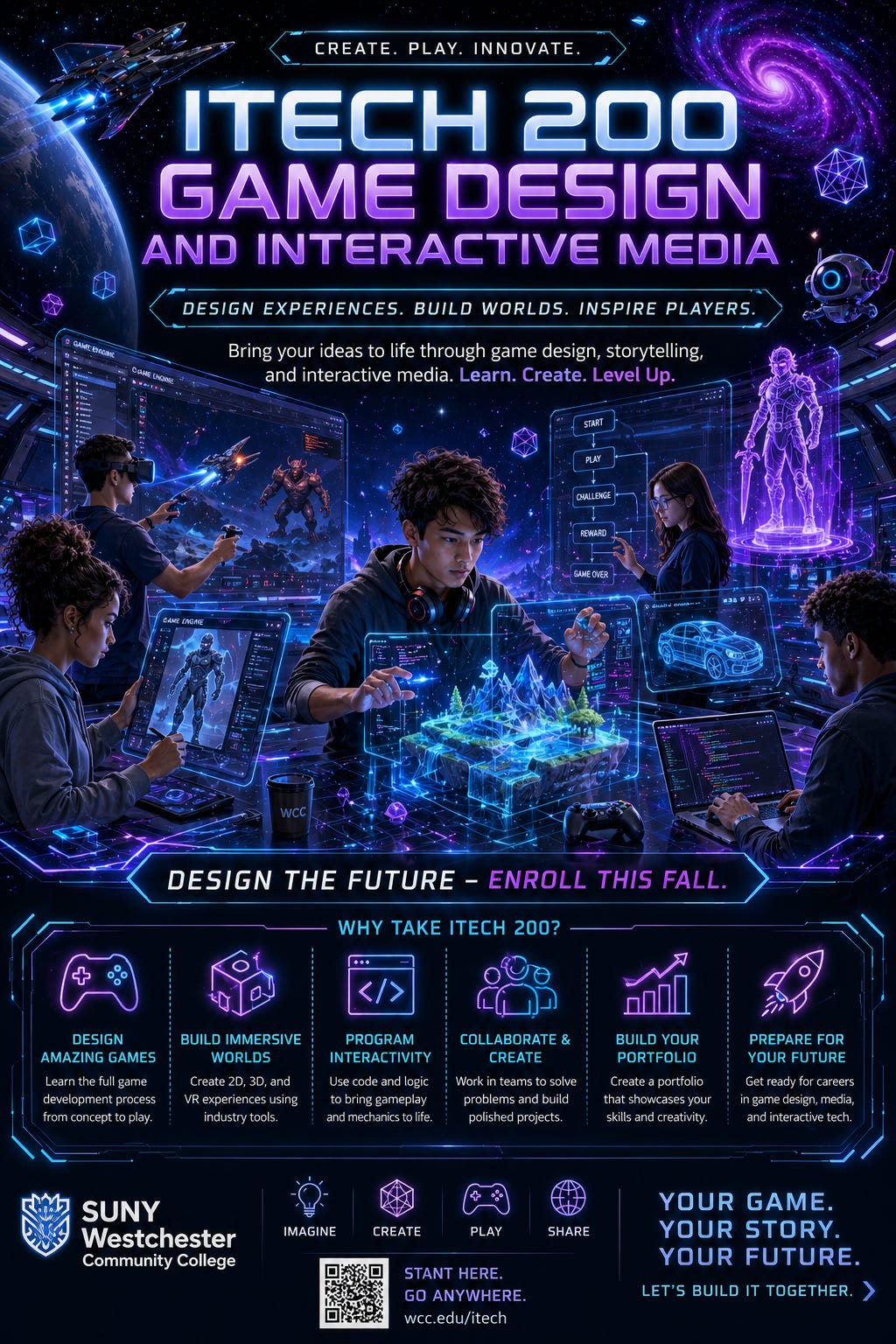
There is a moment every gamer knows. It is the moment the world on the screen stops feeling like a screen. The moment the environment responds to your choices in a way that feels alive. The moment a character moves and you believe in that movement. The moment a sound cue lands at exactly the right instant and something in your chest responds before your mind has caught up. The moment you forget, entirely and completely, that any of this was made.
It was made. By someone. With theory, with tools, with an understanding of how human beings experience interactive environments, and with the discipline to build something that earns that moment of belief.
ITECH 200: Game Design and Interactive Media at SUNY Westchester Community College is where you learn to be the person who builds it.
This Is Not Just a Course About Games
The word game is in the title, and games are absolutely at the heart of this course. But to understand what ITECH 200 is truly teaching, you have to understand what game design actually is.
Game design is the discipline of creating interactive experiences. It is the art and science of building environments that respond to human input, that reward attention, that communicate through image and sound and motion and consequence, that hold a person inside an experience long enough for something to happen to them. These are not skills that belong only to the video game industry. They are the foundational skills of every interactive medium that exists, from mobile applications to virtual reality training simulations, from educational software to medical device interfaces, from augmented reality experiences to the interactive installations that transform physical spaces into living, responsive environments.
When you learn game design, you are learning how human beings interact with digital systems. You are learning what makes an experience intuitive or confusing, rewarding or frustrating, immersive or alienating. You are learning to think in systems, to understand how every element of an interactive environment relates to every other element, and how a change in one place ripples through the entire experience. You are learning, in the most direct and immediate way possible, what it means to design for a human being who is fully present and fully engaged.
That knowledge does not stay inside a game. It goes everywhere you take it.
What the Course Actually Teaches
ITECH 200 provides a foundation in three things that most courses treat as separate disciplines: theory, design, and development. The decision to teach all three together is not incidental. It reflects a fundamental truth about interactive media, which is that you cannot design well what you do not understand theoretically, and you cannot build well what you have not designed with intention.
The theoretical foundation begins with the principles that govern how interactive experiences work. Why do certain game mechanics feel satisfying and others feel arbitrary? Why do some virtual environments feel expansive and others feel cramped even when the geometry is identical? Why does a well-designed feedback loop keep a player engaged for hours while a poorly designed one produces frustration within minutes? These are not subjective questions. They have answers grounded in cognitive science, perception, motivation theory, and the accumulated wisdom of decades of game design research and practice. ITECH 200 gives you access to that body of knowledge and teaches you to apply it.
The design component moves from theory into practice through the creation of an interactive rapid prototype. A prototype is not a finished product. It is a disciplined act of thinking made tangible. It is the designer’s way of asking, does this idea actually work, before investing the full resources required to build it completely. Learning to prototype rapidly and effectively is one of the most valuable skills in any creative technology field, because it teaches you to test your assumptions early, fail cheaply, learn quickly, and iterate toward something that genuinely works. The prototyping process in ITECH 200 is grounded in industry best practices, which means you are not learning an academic approximation of how game design works. You are learning how it actually works in the studios and development teams that build the experiences people love.
The development component introduces a host of multimedia software programs across three categories that together define the modern interactive media landscape. Adobe Creative Suite provides the visual and motion design foundation, the tools for creating the imagery, animation, interface elements, and multimedia assets that populate interactive environments. Three-dimensional animation programs extend that foundation into the spatial dimension, teaching you to build and animate objects and environments that exist in three-dimensional space and respond to the virtual camera and the player’s perspective. Interactive development platforms bring everything together, providing the environments in which design assets become functional, responsive, playable experiences.
Learning to move fluidly between these three categories of tools, understanding how a design decision made in one environment propagates through the others, is the practical education that ITECH 200 delivers. It is the education of someone who can see the whole pipeline and work with confidence at every stage of it.
Why Game Design Is One of the Most Important Design Disciplines of Our Time
The global video game industry generates more revenue than the film and music industries combined. But that number, as striking as it is, does not capture the true scope of what game design has become.
Game mechanics are being applied to healthcare, where interactive simulations train surgeons, help patients manage chronic conditions, and provide therapeutic environments for people living with anxiety, PTSD, and cognitive decline. They are being applied to education, where the principles of engagement, feedback, and progressive challenge that make great games compelling are transforming how students learn at every level. They are being applied to corporate training, to military simulation, to architectural visualization, to physical rehabilitation, to the design of Virtual Reality experiences that allow people to go places and have experiences that the physical world cannot provide them.
The designer who understands interactive media is not limited to any one of these applications. The principles are transferable. The tools overlap. The fundamental question, how do I create an experience that engages a human being fully and serves them genuinely, is the same whether you are building a role-playing game, a surgical training simulation, a language learning application, or a VR environment for elderly patients living with Alzheimer’s disease.
Game design is not a niche. It is a lens through which every interactive experience can be understood, built, and improved. And ITECH 200 gives you that lens.
The Rapid Prototype and Why It Changes Everything
At the center of ITECH 200 is a challenge that will stay with you long after the course ends: build something interactive from an idea, test whether it works, and be willing to find out that it does not.
The rapid prototype is the most honest artifact in all of design. It strips away the polish and the presentation and asks the only question that ultimately matters: does this experience work for the person inside it? A prototype does not care how good your idea sounded in a pitch or how beautiful your concept art was. It cares only whether the interaction, when a real human being reaches out and touches it, does what it was designed to do.
Learning to build rapid prototypes according to industry best practices means learning to move fast without moving carelessly. It means learning to make decisions with incomplete information, to prioritize ruthlessly, to test assumptions rather than defend them, and to treat feedback not as criticism but as the most valuable data you have. These are not just game design skills. They are the skills of every effective designer, developer, and creative technologist working in the modern industry, regardless of the medium or the platform.
The students who go through this process once understand something that cannot be taught any other way. They understand that the gap between an idea and a working experience is where the real design happens. And they understand that closing that gap requires not just technical skill but intellectual honesty, collaborative discipline, and a genuine commitment to the person the experience is being built for.
Who This Course Is For
It is for the student who grew up playing games and always wondered how they were made.
It is for the student who has been learning Adobe Creative Suite or 3D animation and wants to bring those skills into an interactive, dynamic context.
It is for the student who is drawn to virtual reality, augmented reality, or immersive media and wants to understand the design principles that make those experiences work.
It is for the student with a background in healthcare, education, or social services who sees in interactive media a powerful tool for the populations they want to serve.
It is for the student who has taken ITECH 100 or ITECH 120 and is ready to bring everything they have learned about design thinking, user experience, and digital production into the most demanding and most exciting creative technology discipline there is.
It is for the student who has never thought of themselves as a game designer but who cares deeply about how human beings experience the digital world and wants the tools to do something about it.
It is for the storyteller who wants a new medium. For the scientist who wants a new laboratory. For the artist who wants a new canvas. For the builder who wants to create something that responds, that lives, that changes when a person reaches out and touches it.
It is for anyone who has ever been inside a great interactive experience and felt, even for a moment, that anything was possible.
That feeling was designed. Now it is your turn to design it.
Build the World. Then Put Someone Inside It.
Every great interactive experience began as an idea in someone’s mind, a question about what might happen if a player could do this, if the environment responded like that, if the story branched here instead of there. From that question came a prototype. From that prototype came iteration. From iteration came something real, something that another human being could step inside and feel.
That process begins in ITECH 200.
Three credits. A foundation in theory, design, and development. Industry-standard tools across Adobe Creative Suite, 3D animation programs, and interactive development platforms. A rapid prototype built from your own idea, tested against reality, and refined until it works.
And the beginning of a way of seeing interactive media that will inform everything you build for the rest of your career.
Enroll Today. ITECH 200: Game Design and Interactive Media · 3 Credits SUNY Westchester Community College Search for Available Sections